Sunday, 15 September 2019

Brisbane and Coomera

Some heritage remains on the Brisbane River

We had been told to expect Quarantine/Biosecurity at 7.30am. We were up and ready. At 9.30am, Jeremy went to Rivergate Marina Office. The receptionist phoned Quarantine and was told there had been an emergency they had to attend to and someone would come to inspect Sal Darago at 10.00am. Two officers arrived around 10.45am. As it was no longer a public holiday, normal rates would apply of 100AUD plus 50AUD for every 15 minutes spent on the boat. The latter charge can be made for each officer in attendance. We were grateful to be charged for one officer only.
Warehouses converted to apartments on the Brisbane River
Various forms were filled in and Sal Darago was thoroughly inspected inside and out, including the lockers underneath the bunks and the bilges. Afterwards, we were given a clean bill of health, told to take down our yellow quarantine flag and allowed to venture beyond the marina perimeter. We paid total fees of 330 AUD (185.51 GBP). If we’d had any rubbish that needed to be disposed of separately, the marina would have to charge us 150 AUD for this service, which they provide on behalf of Quarantine/Biosecurity.
Brisbane CBD
Throughout the whole process, Jason and the rest of Rivergate Marina staff were very helpful and understanding. We were taken by car to a shopping centre to stock up on fresh produce and collected afterwards. This is part of the marina service for all visitors. In addition, we were charged for only one of our two night stays as we were unable to leave for 24 hours until we’d been seen by Quarantine/Biosecurity. The charge was 74AUD (42GBP). We recommend Rivergate Marina to all visiting cruisers.
Not the Missippi but the Brisbane River
We continued up the Brisbane River the next day and anchored off the Botanical Gardens in the CBD. There were pile moorings nearby and we were lucky to have one of them for three nights. This enabled us to have the use of a laundry, hot showers, toilets and an oar store. We were advised to padlock the dinghy to the landing dock.
Houses with boat docks on the Brisbane River
We enjoyed a walking tour of Brisbane CBD with a very knowledgeable guide and lunch in Pancakes Restaurant. The following day we explored the South Bank visiting an exhibition of art by Margaret Ollie and having lunch at The Plough. We completed our short time in Brisbane with a brisk walk along the riverbank and a trip back on the free ferry.
Tourist Information, Brisbane, in old Regent Theatre
It was now time to start our 59 mile journey to The Boatworks on the Coomera River. This trip took us half a day to plot as it was all on inland waterways and through lagoons. We were very pleased not to have to go out to sea again! We anchored the first night in Horseshoe Bay off Peel Island, where we couldn’t help thinking of our former sailing area of Morecambe Bay and Piel Island in the north west of England. The next day we anchored for lunch off a lovely village called Jacob’s Well and anchored in the Coomera River for the night.
Lunch at Pancakes in a converted church
Next morning, we were visited by two friendly officials who told us we were only allowed to anchor for 24 hours in that part of the river. It was not a problem. Jeremy phoned The Boatworks and reserved a marina berth for five nights. We motored the short distance and tied up to berth F11. Several cruisers had recommended The Boatworks as a good place to haul out, store and work on your boat from as far back as French Polynesia. We were not disappointed. The facilities were first class with just about every type of marine business available on site. In addition, courtesy cars were provided free of charge for trips to the supermarket or elsewhere. There were private bathrooms, several laundries and a liveaboard’s lounge available at no extra cost. Boaters could work on their own boats and live aboard in the work yard.
Nepal Peace Pagoda, South Bank, Brisbane
Sal Darago was hauled out on 29th August, power washed and taken to the storage yard. Normally, boaters are not allowed to live aboard in the storage yard, so we had booked two nights at an Airbnb at Pimpama, where we were welcomed and treated like family.  Jeremy removed the prop shaft and left it with a specialist firm to be checked for trueness.
The pile moorings in central Brisbane
All the usual jobs required for “putting the boat to bed” were done either on the water, in the marina berth or in the storage yard. Just as we were preparing to leave Sal Darago for three months, Jeremy found a substantial diesel oil leak from the diesel fuel injection pump in the engine. This took a while to put right.
Sails drying in the sunshine
The next day, our Airbnb hosts gave us a lift to Coomera Railway Station where we caught a train to Nundah, near Brisbane Airport. We stayed two days and one night at the Prince of Wales Hotel. From there it was a short taxi ride to the airport. The midnight flight to Taiwan took 8 hours and the second one to London Gatwick took 14hrs and 30 minutes.
Haul out at The Boatworks
We arrived in the UK on 2nd September and hardly had time to check our post before we were airborne again heading for the Isle of Man and my sister’s wedding.

SD resting in the storage yard
Our South Pacific adventure was over. Sal Darago had stood up to everything the elements threw at her and took us safely to Australia. OK, she needs a new prop shaft and a lower shroud had to be replaced which is not bad after 8,500 nautical miles. We were sad to leave her, but happy to see our family again. We have another adventure to look forward to when we return to Australia to sail southwards and westwards to the Indian Ocean.

Thursday, 5 September 2019

Passage to Brisbane, Australia

We knew we’d have to pay a penalty for taking a few days out for rest and relaxation. The weather was just right for leaving for Australia as soon as we’d arrived in New Caledonia. However, the forecast for our intended departure date of 6th August gave us a good start with fresh SE winds for two to three days, then turning WNW and increasing to 20 knots as we approached the Australian coast. A more worrying aspect was the swell which would come from the south and could be as high as 5 metres. This was due to arrive just after we reached Australia, so we’d be OK as long as there were no delays.
Big seas and blue skies
It took us an hour to cross the amazing lagoon that surrounds New Caledonia. This gave us time to eat our lunch in relative comfort as there was no swell. Just as we were approaching the pass into the ocean the GPS link to the chart plotter stopped working. Jeremy tried to fix it; I tried to fix it, but we had no luck. Steering by eye and depth sounder and thanking the French for maintaining their navigation marks, we entered the pass. When we were half way through the GPS came on again thanks to further efforts by Jeremy. This sailing life plays havoc with your heart rate!

About half way to Australia there is a long line of seamounts running in a north south direction called the Lord Howe Seamount Chain. Some of these underwater mountains break the surface and make reefs and islands such as Lord Howe Island. Others lie only 5 or 10 metres below the surface. There are a number of gaps in the seamount chain which are 1000 or more metres deep. The navigation has to be pretty accurate to make sure you pass through a gap. The one we chose was 10 miles wide, so what could go wrong?
Kathy tucked under the sprayhood
The wind started blowing from the west making it impossible to sail the planned course. We changed course and headed for another gap. No problem so far. I was on watch in the evening and saw the dark clouds gathering. A squall hit us with 23 knots of NW wind on it. We had two reefs in the mainsail anyway, so I furled the genoa and turned away from the wind losing 8 miles as I was pushed southwards. Jeremy was not pleased when he came on watch and decided to tack. It was then that he discovered tide and current were against us and it was not possible to make headway even with the engine on. We returned to our original course motorsailing with a lighter wind. We were delighted to pass through the seamounts safely and we were able to sail our course to Brisbane close hauled with the wind coming from the WNW.

We watched the barometer drop quite quickly to 1005hp. However, we had clear skies and a moderate wind until a quilted blanket of cloud arrived at 2100 hours. The sea became lumpy and uncomfortable and the wind rose to 28 knots with gusts to gale force. Simon’s birthday was our worst day of the passage. It became obvious that the wind speed indicator was not giving an accurate reading and 24 knots was most likely 34 knots of wind. In addition, the South Pacific Subtropical Current, which normally flows toward Australia at 1.5 knots, reversed in the strong westerly winds. We were going nowhere and having to deal with gale force winds and a huge sea with breaking waves sweeping over the roof and decks of Sal Darago. We sailed very slowly, close hauled with two reefs in the mainsail and our wonderful Hydrovane wind pilot steering. What was odd about this gale was the absence of clouds. The almost full moon was shining brightly and faint stars could be seen.
Heath Robinson!
At 2245 while Jeremy was on watch the bilge alarm went off. Jeremy pumped the water out. His cup of tea spilled all over the cooker so he had that to clean up while SD heeled and bounced along. Fortunately, there was an easing of the conditions during the day but the next night brought several sustained gusts to gale force and a 2 knot current against us. I think we made 59 miles the first day and 30 miles the second day. Usually we clock up 110-120 miles each day.

All things come to an end and sure enough the barometer started to rise, the winds began to go round to the south and the sea started to calm down. Jeremy put out the full genoa after supper and we began to make some progress. I was on watch, the sun had just set and Jeremy was getting ready for bed. Then the genoa started to fall down. I called out to Jeremy and he shot outside in T-shirt and underpants to catch the genoa as it fell. I hooked on to the safety line, hauled the sheet in and stepped out on the side deck to catch the tail of the genoa. Between us we stopped it dropping into the sea. Jeremy bagged it and dragged it into the saloon, where it took up most of the space under the table. A shackle had become detached and dropped off at the top of the mast leaving the genoa upper swivel and halyard up there. All we could do as it went dark was hank on our number 2 jib and take the reefs out of the mainsail.
Felixstowe? No, Brisbane Docks.
The next day Jeremy made a grappling hook out of two metal coat hangers. We managed to use a spare halyard with a line on it to swing the grappling hook towards the genoa halyard. It grabbed and we lowered the genoa halyard to the deck and secured it. I refused to put the genoa back up the slider while we were at sea with water coming over the foredeck and the wind blowing at 15 knots.
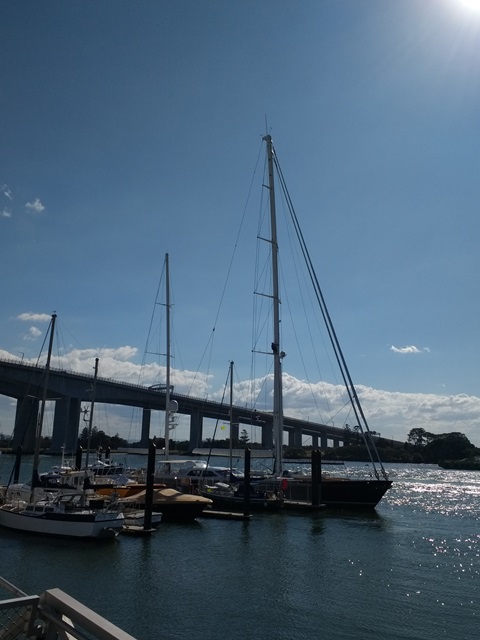
Rivergate Marina, Brisbane River
On Wednesday 14th August at 0105 hours I saw the four white flashes of the lighthouse on Cape Moreton 24.4nm away. Australia was close and, after avoiding some commercial fishing vessels on approach, we entered Moreton Bay and motorsailed towards Brisbane. Jeremy called various authorities on VHF eventually contacting the Australian Border Force. We tied up to berth E14 at Rivergate Marina at 1130.  Jason took our lines and told us it was a public holiday. Oh no! That meant double quarantine fees. Fortunately, there was no fee for Customs and two officers were on board within 10 minutes of our arrival. The Customs and Immigration Officers cleared us into Australia, but we were compelled to stay on board Sal Darago until the Quarantine Officer had inspected us early on Thursday morning.

Sunday, 18 August 2019

New Caledonia

Anyone for oysters?

We had hoped to visit Erromango and Tenna, two islands of Vanuatu that were close to our route to New Caledonia. Unfortunately, they were both to windward and the strong south easterly wind meant that it would be a long, uncomfortable beat to them. Time was running out on us, so we took the direct route to the Havannah Passage on the south east end of New Caledonia.

We had read about the Havannah Passage in our cruising guides. Strong tidal currents ran through this passage and it was advisable to arrive at slack tide and in the light, not an easy thing to plan on a journey of several days.
NORO PACIFIC in Havannah Passage
We left Port Vila, Vanuatu, after an early lunch on Saturday 27th July. We had one reef in the mainsail and put a second one in before we left the bay. The wind was easterly and we could sail our course, although the wind was strong and the sea was rough with waves coming over into the cockpit. At the change of watch, 0300 hours, cruise ship Pacific Aria was going to pass us just over a mile away. This sounds like good clearance but at night it looks very close. Jeremy called them on VHF16. Their response was quick and they were aware of our presence. No worries. We passed each other without incident.

Overnight the wind shifted to ESE and by morning it was SE and easing. We shook a reef out of the mainsail and put the full genoa out. The wind continued to decrease and by 2100 we were motorsailing.  We sang Happy Birthday to our daughter, Emily, just after midnight the next day. Cooler nights were more noticeable. I slept inside my sleeping bag and Jeremy had a 15 tog king size duvet. Full wet gear with several layers underneath was needed at night. The days were sunny and warm. At 0800 I saw land ahoy. It was Ile Lifou, one of the Loyalty Islands and part of the New Caledonia group.
Kathy wrapped up warmly
We were able to sail for about two and a half hours before the wind died away and we had to motor again. Just after midnight, I called cruise ship Pacific Aria. She was astern of me on the same course but going much faster. She had been to Port Vila, disgorged her passengers for the day and was now heading for Noumea, New Caledonia, the same destination as us. Once again, her crew were aware of our presence and they overtook us safely.
Inside the Lagoon, New Caledonia
 Jeremy was on watch as we approached the Havannah Passage in the dark.  There was little wind to worry about but we did have 3 knots of tide sweeping us in. Another ship called Noro Pacific followed astern of us but had to wait for a pilot. We saw the pilot boat approaching from ahead. Meanwhile, dawn was breaking and the skies were lightening. Noro Pacific turned off on a different  channel and we entered a nine mile stretch of UNESCO World Heritage lagoon. By 1440 on Tuesday 30th July we were tied up to a berth in Port Moselle Marina, having called them previously on VHF 67 to arrange this. An officer from Quarantine/Biosecurity came on board while Jeremy was checking in at the marina office. He apologised for taking away all our fruit and vegetables, telling us there was a market on the quayside where we could buy supplies. We were told there was no need to go to Customs. If they had not visited our boat within two hours of our arrival, then they would not come. Oh the delights of still being in the EEC! There was nothing to pay.
A surprisingly long tow
The next day we went to Immigration to clear in. Our passports were stamped and we could stay for as long as we liked – well, until 31st October anyway. We stocked up at Johnson’s Supermarche and at the produce market. We love French islands.

Port Moselle Marina
After two nights in the marina, we decided to go and anchor in Baie Maa for two nights of rest and relaxation. It was very peaceful walking on the shoreline and the reef at low water, meeting locals collecting shellfish and octopus. Jeremy scrubbed SD’s bottom spending only 10 minutes at a time in the water because it was so cold. I did a 5 minute scub of the waterline. We put a course to Brisbane into our chart plotter and Garmin GPS devices. We enjoyed baguettes and camembert. All we needed was constant SE trade winds for the next week to take us to Australia. We didn’t get them.

Coral reef at Baie Maa
We returned to Port Moselle Marina for two more nights. The office staff was very helpful and spoke good English. We had to go to Immigration first, then Customs and finally the Port Office to clear out. We could do this 24 hours in advance. We provisioned SD for our 7 or 8 day passage to Brisbane and went to see all the officials. The only blip was at Customs because Immigration did not give us the clearance papers for Customs. We had to prove we had been in Vanuatu and the date we left. Fortunately, the correct stamps were in our passports. The papers were emailed from Immigration and we were issued with our Customs clearance. There were no problems at the Port Office and no charges. We were free to leave.

Is she standing on the WEST side?
We left a cooking gas bottle to be filled and we were told to collect it on the morning of our departure. The man could not be located and his office was locked. Jeremy went to look for him and had help from the marina office and fellow cruisers. He was found back in his office mid-morning. The gas was paid for and brought back to SD. Just one more job remained before our departure time of 1100 hours. That was to exchange our French Polynesian money to Australian dollars. Unfortunately, the bank could not do this unless we held an account with them, so that was a waste of time.

At 1100 hours on Tuesday 6th August, we slipped our lines, called the marina to thank them and motored out into the lagoon. Our destination was Brisbane, Australia and we had a mixed bag of weather to face.

Tuesday, 30 July 2019

Vanuatu


We left Levuka, Fiji on 18th July after making a three day chicken stew in the pressure cooker. The first 30 miles were a beat south and it was a very uncomfortable and wet ride. We motorsailed. We had to go round the east and south coasts of the big island, Viti Levu. Once we turned the corner, we could set the sails for a beam reach. We had one reef in the mainsail and a small genoa The sea continued to be lumpy and the grey skies produced rain to add to the water that the waves had already dumped into the cockpit.
Floating helicopter in Port Vila
The wind shifted from SSE to SE  to E to NE to ENE over the first 24 hours. Once we’d cleared Viti Levu, we were able to change course for Vanuatu and sail goosewinged with the mainsail on a preventer on one side of the mast and a small genoa poled out on the other side. The sun came out on Day 2.
Children's Day
Jeremy and I both had urinary infections. He started taking antibiotics and I kept mine under control by drinking lots of cranberry juice. The heads were visited regularly.

We had to motor for a while in lovely sunshine but dark clouds were looming ahead. The squally weather hit at night making the sea boisterous and causing more waves to break into the cockpit. We made good progress clocking up 130 miles in one day. The squally weather continued interspersed with bouts of sunshine and gentle winds, until we reached the island of Efate, Vanuatu on Monday 23rd July.
Waiting for lunch
Jeremy called Port Vila Radio on VHF 16 many times, eventually being answered. We were to anchor near a yellow quarantine buoy in Port Vila Harbour and wait for Biosecurity and Customs. Another yacht from Australia, called Golden Cowrie, anchored nearby. The officials arrived about two hours later. We were cleared to continue and go ashore but we had to report to Immigration and other offices to pay our fees. It was too late to do this on our arrival day and the next day was a public holiday for Children’s Day, so we had to wait until Thursday. We had contacted a marina called Yachting World and managed to tie to a mooring buoy there just before they closed.

There was a lovely, family atmosphere in Port Vila on Children’s Day. We wandered around the many shops and were able to change our Fijian dollars into Vanuatan vatu.

The first stop on Thursday was Customs. We took the dinghy past the cargo wharf to the cruise ship wharf, a trip of about 15 minutes.  After Customs, we went around the corner to Immigration and paid 4800 vatu (approx. 48USD). Biosecurity were located at the opposite end of the wharf. Here we paid 5550 vatu. Great, we were cleared in. Later, in town, we bought a Digicel SIM card and did some food shopping. The marina had a laundry service, so we dropped off our washing.

Eating lunch at Rossi's
It was very busy at the marina as the World Arc boats were in port. Now that we had access to the internet, we saw the weather was going to start with easterly winds on Saturday and then turn southeasterly and southerly. Well, you can guess the direction we wanted to go so that we could visit Erromango and Tena on our way south to New Caledonia. Sadly, it would not be possible to go to the two islands and might be a hard sail to New Caledonia. After a few days, the winds were going to strengthen, so we need to leave as soon as possible.
Yachting World office
Our last day was Friday and this time we caught a bus to Customs and Immigration to clear out. The Customs Officer told us we had to pay port fees of 8200 vatu but no-one from the port was at work as it was Public Servants’ Day. The money was put in an envelope and the officer told us he would pass it on to the Port Authority. Round the corner at Immigration there was no-one there. Our friendly Customs Officer helped us again by suggesting we telephone the numbers on the door. There were three telephone numbers. I left a voicemail on the first call and spoke to an officer on the second. Ten minutes later, an Immigration Officer arrived, our passports were stamped and we were cleared to go.

Yachting World mooring field
Last minute shopping followed and lunch in town. In the afternoon we went on board Golden Cowrie and met Steve, Carolyn and Danielle. They are from Adelaide and gave us useful information about anchorages in Sydney and South Australia. They also gave us a SIM card for New Caledonia.

We left Port Vila on Saturday 27th July bound for Noumea, New Caledonia, a passage of 3 or 4 days.