Wednesday, 7 March 2018

Loreto to Bahia Concepcion


Loreto was once the capital of Baja California Sur. The anchorage is an open roadstead exposed to N, S and E winds. Fortunately, there was a fair amount of West in the wind when we anchored off on Monday 19th February.

We went ashore in the dinghy and tied up in the small boat darsena. It was a short walk into town, where there was a large, pedestrianised area called The Plaza with several restaurants and many shady trees. Close by is the historic mission church, Mision Nuestra Senora de Loreto and the Museo de las Misiones. From here, twenty-three missions were built throughout Baja California.
View from the top of Isla Coronados
We had lunch at a popular, roadside, open air café, where we sat at plastic tables on a dirt parking lot enjoying beef tacos. Afterwards, we stocked up our supplies at the two supermercados, El Pescador and Leys.
It was calm overnight, so we stayed off Loreto and motored down to the marina at Puerto Escondido the next day. A large investment has been made at the marina providing pontoons, an office, a shop, a laundry and hot showers. Sadly, it was too expensive for us at 90USD per night, so we chose to go on a mooring ball in the lagoon for 18USD. Each time we went ashore it was a 7-10 minute dinghy ride depending on the wind waves.
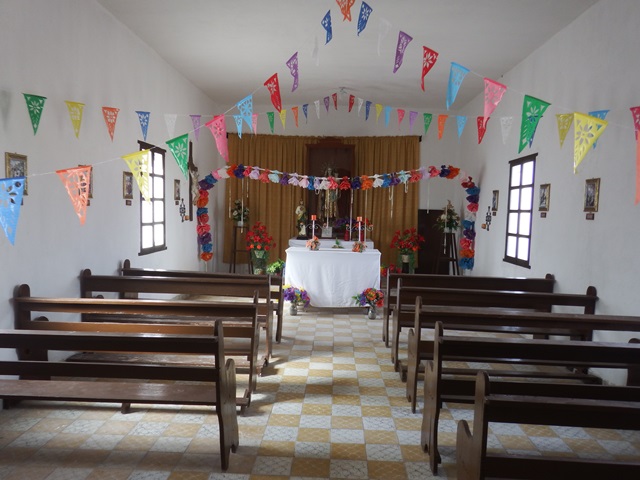
Inside view Mision Nuestra Senora de Loreto
The wind blew strongly from the north and it was cold. Out came our fleeces and thermal socks once again. Ashore, only the office with a work area for cruisers and the shop gave shelter from the cold wind. The food in the restaurant was good but it was open to the weather on all four sides. We had three nights at Puerto Escondido. There was a Cruisers’ Net every morning at 0800 on VHF 22A with a good five day weather forecast.
Mision Nuestra Senora de Loreto
The data on my phone had stopped working at Puerto Ballandra, after only 12 days’ use of the 30 day contract. Soon afterwards, Jeremy’s data stopped working as well. Jeremy topped his up online translating the Spanish instructions. I was not prepared to give the phone company any more money, so I used the Wi-Fi at the marina office to book flights and some of the attractions for our Canada trip in May.
Picking my way down from the volcano
Early on Friday morning, 23rd February, we left Puerto Esdcondido and motored back to the anchorage off Loreto in a very light southerly wind. When we returned having had lunch and been shopping, the wind had turned to the NE and the wind waves were building. Sal Darago was bouncing on her anchor. We knew strong northerlies were coming, so we weighed anchor and motored seven miles to Islas Coronadas. The only other vessel at anchor was a catamaran called InnCredible.
On top of Isla Coronados
The gas ran out as the pressure cooker was coming to the boil. Fortunately, we had more cylinders on board. The NNW wind blew to 24 knots, wind waves were breaking on the beach, so we did not go ashore. We spent the day navigating and booking rental cars, hotels etcetera for our land trip. We ventured outside for sundowners in the late afternoon and it was cold in the wind.
The lighthouse and darsena wall Loreto
The sea was quieter on Sunday and a few pangas landed passengers on the beach. We went ashore in the dinghy and decided to hike to the crater of the volcano on Islas Coronados. The first part was easy walking on a path through the sand dunes. The middle part was a scramble over rocks and boulders and the last part was a slippery, slidy path, which zig-zagged upwards. The spectacular view at the top was worth the effort. I put my knee support bandages on for the downhill crawl.

Moorings in the lagoon Puerta Escondido
On Monday 26th February, we had less wind and only 22 miles to go to Caleta San Juanico. The swell through the inner passage between Islas Coronados and Baja was quite big, but it was long with no breaking waves, so SD glided over the sea giving us a comfortable ride. All this was to change by mid-day when the 5 knots of WNW wind shot up to 19 knots from the north. Yes, we were going north. Short, sharp, breaking waves smacked against the hull.
One of the windows in the lagoon
Two hours later, we reached the shelter of Caleta San Juanico. We saw a yacht aground and heeled over on a reef near the shore. It was S/V Veraison with Andrew and Tamara on board. They had offered us a lift into Loreto when we were in Puerto Escondido. We anchored behind S/V Quick, launched the dinghy and went over to help Veraison. Nothing more could be done until high water. On the way back to SD, we saw a motor cruiser, named Suzie, from Yellowknife, Canada. Our friends of five continents, Ann and Barry from S/V Cat’s Paw IV, come from Yellowknife, so we had to stop and say hello. Janet and George invited us on board and soon we were drinking tea, eating scones and talking about the games of Bridge, we had all played, at different times, with Ann and Barry.
Early start. Marina Puerta Escondido
At high water, the combined efforts of many cruising men and women careened and tugged Veraison off the reef, just before dark. Thankfully, she was not taking on water.
Tequila Sunrise!
All the weather forecasts told us that the next day, Tuesday was the best day of the week for going north. We left at first light at 0620 in 3 knots of wind. By 0900 we had two reefs in the mainsail, a tiny genoa and 20-26 knots of wind from the WSW. Jeremy was soaked by a wave as he went forward to adjust the reefing line. For a short time it was almost calm. Then the wind changed direction and gave us 22 knots from the SSW. S/V Quick called us on the VHF radio to ask us about the weather as we were about an hour and a half ahead of them. They had also been surprised by the gusty conditions.
Playa Santispac Bahia Concepcion
We turned into Bahia Concepcion and managed to put the mainsail to bed in a brief lull. Several yachts were anchored off Playa Santispac in Bahia Coyote. We dropped the anchor off the white, sand beach lined with RV’s as large as buses. A bar on the beach was starting “happy hour” but we were too weary to launch the dinghy and go ashore.

Monday, 19 February 2018

Honeymoon Cove to Puerto Ballandra


Honeymoon Cove, Isla Danzante
Isla Danzante
Honeymoon Cove
Where would you go on St Valentine’s Day? We headed for Honeymoon Cove on the north end of Isla Danzante. We had the south cove to ourselves and stayed for 2 nights. The snorkelling was excellent and the short hikes up the hill were on good trails, except for the one up to the highest point, which was almost vertical in places and very slippery on loose stones and gravel. We turned back and slithered down. 
Walking on Isla Danzante
An American catamaran called Goblin was anchored in the middle cove with Alan, Jennifer and Katie on board. They invited us for a cup of tea and we enjoyed chatting and exchanging sailing adventures. Sarah from the 65ft MacGregor, Illusion, whom we’d met in Bahia Ballandre, near La Paz, joined us for a while.
Isla Carmen from Isla Danzante
Isla Carmen
We had decided we would definitely go into the marina at Puerto Escondido, 3 miles away, on Friday morning. Just before leaving, Jeremy suggested circumnavigating Isla Carmen and going into the marina on Tuesday, as not all businesses are open at the weekend.

Sal Darago in Honeymoon Cove
 We rounded the north of Isla Danzante and the south of Isla Carmen and anchored near S/V Maiwej in Punta Colorada. 

Puerto Colorada
Just before we lost our intermittent mobile phone signal completely, I received a message from my sister, Pat, saying our 92 year old Mum had been taken ill that day and her care home had sent for an ambulance. Pat and my other sister, Sara, were about to go on holiday and did not know if they would get away. After two anxious days, our phone signal returned as we came round to the west side of Isla Carmen. Mum is OK. The paramedics were able to bring her blood sugar back up and Pat and Sara were able to go on their holiday.

We snorkelled on the excellent reef at Punta Colorada and walked along the pebbly and rocky beach. Jeremy broke a dinghy oar rowing ashore. He was able to do a temporary repair so I could row gently back to SD. Later, a permanent repair was made and now one oar is two inches shorter than the other.

Full cupboard, but the house is demolished?
Bahia Salinas
Yesterday, Saturday 17th February, we spent the night at Bahia Salinas on Isla Carmen. Catamaran La Ballanos Too with Jim and Chris on board was the only other vessel on anchor in the huge bay. They had been our kind and helpful neighbours in Marina de La Paz. It was good to see them again. 

Two wheels on my wagon ....
Jeremy and I went ashore in the dinghy to explore the ghost town and the vast salt pans, where 200 people lived and worked until the mid 1980’s. Some of the  buildings have been converted into a hunting, shooting and fishing lodge. This part is private. As long as you respect that and ask permission to look around the ruins from the caretaker, you are allowed to wander about for as long as you like. 

It is not snow, it is salt
It was fascinating trying to work out how the factory buildings operated and how the salt was transported from the pans to the jetty. On our return, we stopped at La Ballanos Too and had a cup of tea and a long chat with Chris and Jim.

The church
Puerto Ballandra
It was quite a bumpy ride in the swell as we rounded the north end of Isla Carmen this morning. Strong north winds had been blowing for the last two nights. The wind had calmed but the sea always takes a little longer. Here in the southern part of Puerto Ballandra there is not a breath of wind and it is raining. We have both had a swim and think the water is as cold as Calgary Bay, Isle of Mull, Scotland in midsummer. I have seen two big horn sheep on the nearby cliff which are as big as the Scottish mountain goats.

Tomorrow, we re-enter civilisation at the town of Loreto.


Sunday, 18 February 2018

Isla Espiritu Santo to Bahia Agua Verde


Someone took the water away

Isla Espiritu Santo
We anchored for two nights in Bahia San Gabriel. A long, white beach lined the anchorage. During an afternoon siesta, we awoke to the sound of buzzing. A small swarm of bees had invaded the cockpit and the saloon. After some persuasion with the fly swat, they retreated out of the saloon and we put all our insect nets in place. The bees stayed in the cockpit. Our cruising guide mentioned that bees can come looking for water and we had a bucket of La Paz fresh water on our side deck. No wonder we were being invaded. No-one was stung and once the water was removed from the deck many of the bees went home.
Beware pricks when walking
It was with some trepidation that we ventured outside later with our snorkelling gear and portable shower and headed for the shore. On our return, all the bees had gone but we kept the insect nets in place.

There is a trail that leads from Bahia San Gabriel, across the island to Bahia Bonanza. The next day, Thursday 8th February, we donned our walking shoes, forgot our walking poles again, and set off into the desert. Before long we were following footprints and feeling a little like Winnie the Pooh as we followed them round giant cacti and prickly bushes towards our distant destination only 2 miles away. I think we walked quite a bit further. Anyway, we made it there and back safely.

On our return, the tide had gone out a long way. Fortunately, our dinghy has wheels, but it was a long haul across the sandbanks to deeper water.
Striated cliffs at La Raza
Ensenada de la Raza
In the afternoon, we motored four miles north past Isla Gallina and Isla Gallo and anchored. We snorkelled to the northern shore. I found that my shoulder was too painful to swim front crawl and had to use breast stroke arms at a slow pace. (My sore shoulder is as a result of being rescued from falling in at La Paz.) I wasn’t sure that I could swim back, so Jeremy swam ahead to fetch the dinghy. Soon afterwards, a turtle swam beneath me, gliding along effortlessly. I realised that all I had to do was keep moving my arms and legs and I would make it back to SD. I was almost there when Jeremy arrived with the dinghy. I kept swimming and made it safely back to the boat.

Was the view worth it?
Isla Partida
On our way to Ensenada Grande we motored between Isla Ballena and Isla Partida. It was a journey of 7 miles. We anchored off a cove adjacent to a large, white fishermen’s cross on the hillside. Ashore, a number of kayakers had set up camp. We decided to hike the “well marked” grade 3 trail, assuming grade 3 was probably about average. We had our walking poles and we followed the markers. Very soon we were clambering over boulders and snaking upwards along a dry river bed. I had to put my knee support bandage on. It was hot, strenuous work. The trail ended at the top of cliffs on the other side of the island, with good views. The return hike was just as strenuous and I decided at the bottom that the view was not worth the effort. Now that a little time has passed, I think that it probably was.
Yet another San Francisco and no bridge
Isla San Francisco
The southern anchorage here is picture postcard perfect with a curved, white sand beach at its head. We went in the opposite anchorage, Agates Bay, as southerly winds were forecast. S/V Lucy was the only other vessel anchored with us with Christian and Karen on board. Christian had caught too many fish and gave us a grouper, which was delicious a day or two later, when we had finished our beef stew. We snorkelled the eastern point and walked across a dry salt pond to view the southern anchorage. The south winds did not arrive and we pitched in easterly swell until morning.

La Coyote, microscopic village on tiny island
San Evaristo
Our next destination was ten miles away on the Baja Peninsula. Ashore there was a small tienda and a desalination plant. It was Sunday, 11th February, so we deferred going ashore for food and water until Monday. S/V Amelie, registered in Jersey, with Steve and Debbie on board was the second British vessel we’d seen since leaving San Francisco. We were invited aboard and spent the afternoon exchanging sailing adventures over a few drinks. The next day, we took the dinghy ashore and learned that the tienda was closed as the owner had gone to La Paz for supplies. We returned to SD with 20 litres of fresh water, but no fresh food.

San Evaristo church
Los Gatos
We weighed anchor straight away. Northerly winds were forecast and our next anchorage was 25 miles north at Timbabiche. We sailed for a while in easterly winds and a swell built up from the south east. It would be too uncomfortable at Timbabiche, so we continued for a further 3 miles to Puerto Los Gatos and anchored between two reefs in the southern part of the bay. We both had a swim. The water was fairly cold.
Sunrise at Los Gatos
Bahia Agua Verde
The next day was cloudy and calm. We motored 18 miles to Bahia Agua Verde seeing 10 dolphins on the way. A large ray jumped out of the water a short distance away. We anchored in the northern cove with three other visiting vessels. By evening there were 10 or 11 boats and it was becoming crowded. Ashore, we found a well-stocked tienda in the village. We bought fresh fruit, vegetables and some beef steak. The local speciality was goats’ cheese, so we bought some. Then we were shown local needlework and bought a cushion cover sized piece of fabric showing an embroidered turkey. Emily will love it or perhaps Simon will prefer it?

Leaving Agua Verde at dawn, Roca Solitaria

Wednesday, 7 February 2018

Cabo San Lucas to La Paz


Leaving Cabo San Lucas and the two cruise ships
The Westerly Owners Association (WOA) held their AGM on 27th January 2018. We were awarded the Rayner Challenge Plate for our trip from the River Deben in England to San Francisco in the USA. According to the WOA website: “The Rayner Challenge Plate, our oldest and most prestigious piece of silverware, is awarded annually for the ‘Best Cruise undertaken in a Westerly’.” We felt proud and honoured to receive such a prize for the third time, but the glory must go to our 43 years old Westerly Solway, Sal Darago.
Los Frailes beach from the top of the hill
Back to Cabo San Lucas. We weighed anchor at 0635 on Thursday 25th January and started the 45 mile passage north to Los Frailes. A steep rise in the barometer gave us prior warning of what was to come later. Sure enough, by midday we had 25knots of NE wind kicking up short, sharp, steep waves. We motorsailed and tacked, bouncing the rest of the way in an uncomfortable sea. We were relieved to drop the anchor in the shelter of Cerro Frailes at 1640. We were the only boat in the anchorage.
Queen of the castle
We were in Los Frailes for six nights as the wind, known locally as a Norther, blew hard. We heard later that the port of La Paz was closed during this blow. We used the time to climb up to the top of Cerro Frailes, where we had a good mobile phone signal, to walk to the village of Cabo Pulmo 9.5 kilometres away, to swim and snorkel and to walk on the vast beach. Ashore, there was a small, local fishing camp and a few houses. The restaurant had closed down. Usually, only a handful of people were on the beach, so we had this unspoiled beach largely to ourselves.

The long and dusty road
Each day the beach landing became more difficult as the surf increased. My left knee had swollen up from the mountain climbing and walking. I made things worse by falling in the surf and grazing my knee on the sand. As Jeremy jumped out of the dinghy he caught his shin on something and arrived on the beach with blood dripping down his leg. The few onlookers observed in silence.

Some south going yachts came and left. One ketch waited with us to go north. We both left early on Wednesday 31st January for a quiet motorsail of 46 miles to Bahia de Los Muertos, the Bay of the Dead, recently renamed by developers, the Bay of Dreams. We anchored in Ensenada de Los Muertos amongst a small flotilla of yachts, the most we had seen in one place since Turtle Bay. (The Muertos refer to mooring weights not dead men – work it out?)

Balandre beach
The next day we followed the flotilla out of Muertos to the Canal de Ceralvo, motorsailing close to a sandy spit on which stood a lighthouse reminiscent of the Point of Ayr off the Isle of Man. By lunchtime we were able to sail almost all the way through the Canal de San Lorenzo to Puerto Balandre. Once again, about 14 boats were anchored here. We went ashore in the dinghy (no surf), walked round to see Mushroom Rock and I snorkelled back to SD from the beach. Jeremy had to keep his wound dry, so he rowed back in the dinghy.

Tricky entrance to La Paz, well buoyed
It was only 12 miles to La Paz, so it seemed like no time at all before I was speaking to Marina de La Paz on the VHF to ask if they had received our email request for a berth for 4 nights. There was some confusion, but a berth was allocated and then the fun began.

Nuestra Senora de La Paz
There is a tidal flow through the marina, so Jeremy was going a little faster than usual as he turned into the pontoon berth. The gap between SD and the pontoon was widening but I jumped down with our line, the pontoon tipped towards SD and I was falling in. A strong hand gripped my arm and hauled me upwards. I banged my sore knee on the pontoon and only my right foot and lower leg were wet. I was shaken and my pride was hurt as an audience of three watched our arrival. Everyone was helpful. Jacob, the Mexican, who had saved me, took the stern line and Jim, from a catamaran nearby, took the bow line, giving it to his wife, Chris, while he helped to secure SD. Thank you to all our helpers and rescuers.
Guess where?
Checking in was easy at the marina. There was a laundry on site, hot showers and a restaurant. In town there were several good supermarkets and restaurants. We sampled a few of each. We joined the Club Cruceros (Cruisers’ Club) and listened to the morning Cruisers’ Net on VHF 22A. La Paz is an excellent place for provisioning, boat parts and boat storage.

One of the many sculptures on the malecon
Jeremy celebrated his birthday at La Paz. His first job was to mend the toilet. The flush pump handle housing split on four of the six retaining screws. The day improved and we ate out for lunch and dinner. But ill luck returned as the mains electricity failed on our return to SD.

Birthday lunch at Claros
We left La Paz at 1350 on Tuesday 6th February and decided to motor to Isla Espiritu Santo, as the wind was light. Three boats anchored here overnight. We have another large, white, sandy beach to explore in this National Park.